Save The Tiger  
 
Home
Profile
Travel Reports
Save The Tiger
B2 of   Bandhavgarh
Jhurjhura Tigress
Tiger News
Picture Gallery
Sales
Guest Book
Contact
Links
 

TRAVEL REPORTS


Yellowstone/Grand Teton National Parks, USA-September/October 2011

During Autumn I travelled through the States of Idaho, Montana and Wyoming to spend time photographing the beautiful scenery and wildlife in these wonderful parks.  Due to the unseasonally warm weather many of the animals that I had hoped to see remained on high ground but the magnificent scenery and changing Autumn colours was beathtaking. A small number of my photographs can be seen by following the link to the 'PICTURE GALLERY'. 

 White Tailed Eagles of Norway-July 2011


With most of the tiger reserves In India closed until after the monsoon I took the opportunity to fly to Norway in July for 5 days to photograph the White Tailed Eagles on the Norwegian fjords. I was extremely lucky to see and photograph these magnificent raptors as they soared in the sky close to my boat and then dived to catch fish in the water below.  A small selection of my images can shortly be seen in the Picture Gallery section of my website.

 Ranthambhore-May 2011


I departed for India on 6 May returning once again to Ranthambhore National Park where I remained for almost three weeks.  It was a wonderful experience to return to the tiger reserve that means so much to me and which I have visited many times over the past few years.  I enjoyed many memorable tiger sightings totalling twelve different tigers seen within the tourist area of the park during this visit. Of particular interest to me was seeing the well known and now aged tigress T.16 (perhaps better known as 'Machali'). Prior to seeing her I had received varying reports as to her condition;  she is now in her twilight years being fourteen years old.  I am advised that the Forest Department are helping on occasions to supplement her feed as although she is still able to make a kill this is becoming less frequent.  However when I finally saw her again she looked well as she steadliy walked close to my jeep, marking and patrolling her home range.  I also witnessed a male tiger, T.25, mating with with T.17, one of 'Machali's' daughters from her last litter.  T.17 is collared and is one of three siblings, two of which have their home ranges at Ranthambhore; the third was relocated and now inhabits Sariska Tiger Reserve.  I understand that T.17's collar will be removed once the authorities believe that it is safe to do so as it would of course be dangerous to tranquilise the tigress if she is pregnant.  One of the most interesting facts that I discovered at Ranthambhore was that the two seven month old cubs of the late tigress known as T.5, are now spending much of their time with their father T.25.  If the cubs survive to adulthood with the male tiger taking over the role of their late mother, then this will be ground breaking news in tiger behaviour.  The photograph accompanying this report is of T.39 a tigress who had made a kill of a Sambar deer the evening before I took this picture. After she had made the kill and had feasted on her prize she left the carcass safely hidden in a cave to feed on the following day. I was lucky to be close by as she appeared from the cave to feed.  A selection of the photographs from my visit can be seen by following this link to the 'Picture Gallery' section of this website.


 Bandhavgarh February/March 2011

The last walk of the Siddhababa/Chorbera tigress


I arrived at Bandhavgarh on the 27 February for a two week stay. During my time spent at the reserve, I enjoyed some excellent tiger sightings including a distant view of B2 (Sundar) as he walked the hills and through the dense forest on his way to visit the 'Mirchani' tiger family (a tigress-together with her three sub-adult cubs that he had sired).  In the early morning of the 2 March, I saw the Siddhababa tigress as she patrolled her home range and was pleased to note that the disability she had sustained to her offside hind leg some 18 months ago appeared to be improving as she silently vanished out of view.  During that afternoon, while my vehicle was stationery at Aama Nallah, I heard the frightening sound of tigers fighting.  Three days later the Siddhababa tigress's remains were discovered, partially eaten by the challenging tigress, who now occupies the area of the park around the Chakradhara meadow.  It is very rare indeed for a tigress to kill another female -it is even more unusual  for the dead tigress to be partially devourerd by the other.  I will always remember the nine year old Siddhababa tigress, whose life I have been following for many years, especially during the time that she successfully raised cubs from two litters.  The two cubs from her last litter, born in August 2009, are male and female.  We must hope that the female will eventually take over her mother's home range.  Photographs from my visit to Bandhavgarh can be viewed by following the link to the 'Picture Gallery' section of 'tigersintheforest'.  


Katmai National Park, Alaska - August 2010


 I returned home at the end of August from the west coast of the USA having spent time in Katmai National Park photographing the Brown (Grizzly) bears.  They were concentrating their efforts trying to catch Pacific salmon, which make their way up the rivers and streams to spawn.  Each year the salmon attempt this hazardous journey to return to their place of birth where the female lays her eggs - these are fertilized by the males before both sexes die from exhaustion after their arduous journeys.  On their way up stream they face many problems not least of all from the bears that are waiting to feast on them.  The bears will need plenty of extra weight to enable them to hibernate in November when their metabolism slows down.  They will emerge from their dens the following Spring.  I, and a small party of photographers, watched from the banks of a shallow river which led directly into the sea, as the salmon proceeded on their perilous journey while the Grizzly bears of all size and age focused on catching the fish.  There were very large males, also mothers with Spring cubs, young males and females, together with older cubs, all intent on feeding on the salmon.  Sometimes squabbles broke out between the sows and their offspring when a salmon was caught - the youngsters making growling sounds as they were eager to have a share of the catch, but mum needed first feed to keep up her strength to cope with nursing cubs!  One very large boar thought to be approximately fifteen years old was particularly adept with his fishing skills - he constantly dipped his huge head under the clear water (apparently unusual for most bears) enabling him to succeed in his efforts.  We were told that a bear is able to consume up to 70 lbs of fish each day in order to increase its weight to the maximum before the harsh Winter sets in.  More photographs can be viewed by following the link to the 'Picture Gallery' section of this website.


Bandhavgarh-May/June 2010

A tribute to the Jhurjura Tigress


I arrived at Bandhavgarh on 22 May with the main objective to photograph the Jhurjura tigress together with her three cubs (about 6 month old).  However, on arrival I was told that on the evening of the 18 May persons had illegally entered the park for a "night drive" and had mortally wounded the tigress by repeatedly hitting her with the vehicle in which they were travelling. At the time of writing this report, the tragic event is under investigation by the relevant authorities and it is a fact that three senior forest officers have been suspended from duty over their possible involvement in the crime.  Besides loosing a comparatively young tigress, there is now the matter of the cubs to consider.  I am advised that the park authority are providing food and some protection for the cubs.  I believe that it is intended to place them in a safe area within the boundary of the reserve until they are old enough to be released into the wild.  Although nothing can be done to bring back the tigress, I truly hope that the perpetrators of this wicked crime be brought to justice and pay the price for their selfish intrusion into the tiger reserve at night.  In June 2009 I spent considerable time at the Rajbehra meadow/dam, photographing the Jhurjhura tigress together with her previous litter of cubs all of whom flourished under her care.  I hope that one of the female cubs from that litter will now settle and take over her mother's home range.  As a tribute to the Jhurjura tigress, I am showing the photograph above that I took of her together with two of her cubs from the previous litter in June 2009.  This was the last time that I was to see this beautiful tigress and caring mother.  A number of photographs from my visit to Bandhavgarh are available in the "Picture Gallery" section on this website.


Ranthambhore - March/April 2010


I have just returned from a successful visit to Ranthambhore national park - it is early April 2010.  My trip was over a period of twenty days from the latter part of March.  Leaving cold and wet England I was happy to be heading to the warmth and looking forward to catching up with the tigers of India.  On this occasion, I photographed eight different tigers and talking to my guide I was able to update myself with news of those that I had seen before and newcomers!  Machali is now 13 years old and the photograph included shows her lying flat close to the jeep before she charged at a small group of Sambar deer.  A chance to produce a meal obviously takes priority over a bunch of humans wanting to take her photograph!  More photographs from my visit to Ranthambhore can be seen by following this link to the "Picture Gallery" section of Tigers in the Forest.


 Pench, Kanha & Bandhavgarh National Parks-        October/November 2009  


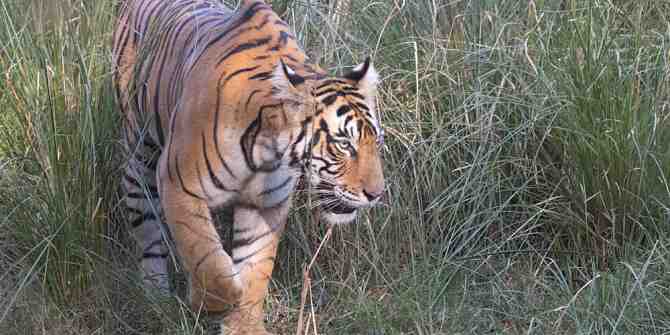
I returned home from India on 4 November having spent almost three weeks travelling within the tiger reserves of Pench, Kanha and Bandhavgarh.  My journey commenced at Pench where I remained for three days.  The National Park is located in the Seoni and Chindwara districts of Madyha Pradesh and the beautiful park area is a blend of both dry and moist deciduous and tropical forest with the Pench River meandering through the entire 757 sq km stretch of the reserve.  Unfortunately, during my stay, I was unsuccessful in sighting any of the park's tiger population.  This may have been due to the disturbance caused by the forest department in attempting to tranquilise a male tiger for the purpose of relocation to Panna tiger reserve.   From Pench I travelled to Kanha tiger reserve which is situated in the heart of the Sal forests within the central highlands of India.  Here I enjoyed some magnificent sightings of tigers, leopard and even sloth bear.  After four productive photographic days at Kanha I departed for Bandhavgarh tiger reserve where I was to remain until my departure for Delhi on 3 November.  My time at Bandhavgarh was spent in both the Tala and Magdhi ranges of the park.  Although I did not see my favourite tiger, 'B2', I was assured that  he was well and continuing to patrol his home range and visit the tigresses with whom he has mated.  However, in the Tala range I was delighted to photograph the Jhurjura tigress with one of her sub-adult female cubs (last June I had spent much time watching them both at the Rajbehra dam).  I was also able to see the Mirchani tigress together with her three young cubs and one of the sub-adult male cubs from her previous litter.  The photograph above was taken on 24 October at Kanha showing a male tiger that I had followed by jeep just as he was about to leave the track and disappear into the forest.  A selection of images from my visit to the three tiger reserves in India can be found by following this "Link" to the 'Picture Gallery' section of 'tigersintheforest'. 


Svalbard-The Arctic June 2009

I returned from the Arctic at the end of June 2009 having spent eleven days on the Russian ship, Vavilov, travelling the archipelago of Svalbard.  The journey was mainly to try and photograph wildlife-polar bears, walruses, seals and birdlife which included King Eider, Kittiwakes, Guillemots, Little Auks, Northern Fulmer, Puffins, Purple Sandpipers and more.  The scenery was stunning with vast glaciers, frozen pack ice and blue sky.  The twenty-four hour daylight also puts a very different slant on things!  During my time in the frozen north we travelled in zodiacs (dinghies) from the ship amongst broken sea ice and at times were able to land on shore.  We trekked a little way over the enormous glaciers and standing still were able to hear the constant 'groaning' of these enourmous mountains of ice, watching as parts of them slid into the icy sea.  Polar bears came into view one morning!  Firstly a mother and her cub-she was hunting the ice for seals-and then we were lucky enough to see a huge male hunting.  Although the sightings from the ship were a considerable distance away due to the frozen sea, it was wonderful to see them in their own backyard against snowy peaks and glaciers.  A small number of my images can be seen by following this "Link" to the 'Picture Gallery' section of "tigersintheforest". 

Bandhavgarh May/June 2009

I


I returned from Bandhavgarh on 10 June 2009.  During my stay I enjoyed excellent tiger sightings.  Most of my time was spent in and around the Rajbehra/Suhari meadows being the home range of the Jhurjura tigress and her three cubs (two female and one male).  On one occasion I was able to see the tigress and her two female cubs at the Rajbehra lake where they bathed and enjoyed the cool water escaping from the intense heat of the day (my photograph above).  For a few days the cubs' father known as 'Bokha', a large powerful male being about nine years of age, appeared with the sole intention of mating with the tigress. However I do not believe that she was in oestrus as she was still caring for her young cubs and on one occasion she became increasingly aggressive towards him as he approached her. Where the tigress had rested I watched 'Bokha'  as he 'tasted' the ground with his nose and tongue - this behaviour is known as flehmen.  During my regular visits to that area of the park I could clearly hear the deep rumbling sound from the forest as the two adult tigers growled at each other.  B2 (Sundar),now at twelve years of age, is well and during my stay entered the buffer area of the reserve where he reportedly killed a cow. Within the Tala range of Bandhavgarh there are now three large male tigers including B2, 'Bokha' and a new male tiger that I was fortunate to photograph on my last day. This new male is huge, much larger in size than either B2 or 'Bokha'.  He was one of four cubs born to the 'Chakradhara' tigress and sired by B2 just over four years ago. B2 appears to have reduced his patrolling to the home ranges of the Chakradhara, Mirchani and Vanvaye tigresses where his cubs are to be found. Unfortunately it is now almost certain that the Vanvaye tigress is dead (see article below) but I am pleased to report that her three eighteen month old cubs are making kills and continuing to prosper.  A selection of my photographs from Bandhavgarh can be seen by following this "link" to the picture gallery section 


Ranthambhore March/April 2009-a tribute to a beautiful tigress


My Spring 2009 trip to the national park of Ranthambhore did not disappoint with tiger sightings most days during my two week stay.  However, this visit was tainted by tragedy and sadness.  A tigress I had seen on numerous occasions was killed on the night of the 3 April.  Conflict with a large male tiger proved fatal.  On the 2 April, during an early morning search, my guide and I discovered the tigress as Bakola; it was clear that she was in discomfort and limping badly from an injury to her nearside front paw, possibly caused by a thorn in her pad.  We watched as she limped to a nearby pool where she appeared to take comfort from resting her leg and paw in the cool water.  Due to these circumstances it was going to prove difficult for her to protect herself and attempt a kill to feed herself and her two seventeen months old cubs.  We left the reserve and immediately made a report to the Deputy Forest Officer who promptly made arrangements with his staff to take meat to the tigress and her two cubs and also assess the damage to the female's paw.  However, some time during the evening of the 3 April, it appears that a male tiger entered Bakola and a fight took place.  It is most unusual for a male tiger to kill a tigress although if the male is not the father of the cubs he will sometimes attempt to kill them in order to bring the tigress back into oestrus to mate with her himself.  Over the past three or four years, I can clearly remember regularly seeing the young Berda female. initially as a cub with her mother and two brothers and then maturing into a beautiful tigress.  I particularly remember two separate occasions once at a water hole at Berda Valley, with the young tigress together with her two male siblings and mother enjoying swimming in the cool water and, secondly, some months later and still with all her family, I photographed them resting on a track leading from Berda to Lahapur.  Sadly, about a year later, her mother and two brothers were poached and I understand that the criminals involved were subsequently apprehended.  The young Berda tigress prospered and took over the home range of her dead mother.  About seventeen months ago she gave birth to a male and female cub of her own that she has successfully raised, however, at this age tiger cubs are still very inexperienced with regards to hunting and fending for themselves.  Young tigers usually remain with their mother for about two and a half to three years in order to learn these skills.  My hope now is that the Berda tigress's youngsters survive and hopefully the female cub will inherit her mother's home range.  I am aware that the Forest Department are providing additional food for them and I feel confident that the tigress's dynasty will continue.


Always at Ranthambhore a priority for me is to find the tigress known as 'Machali' whose life I have been following for a number of years.  She is now approximately thirteen years old having successfully reared four litters of cubs.  Amazingly she now has only one canine tooth remaining!  However, what she lacks in teeth Machali more than makes up with experience and during my visit she managed to bring down and kill a large Sambar deer in the valley of Bhoot Khora.  On a later occasions I saw her having a confrontation with a large male tiger that two days earlier had clearly stumbled across the carcass of the deer and had decided to 'muscle in' to finish the remains.  Although Machali could see the male tiger while he gorged himself on his unexpected feast, she seemed unconcerned.  A little later he started to follow her to Kachida and would not leave her alone.  I watched as she lay flat by the side of the track with her ears back, aggressively looking at her pursuer, then suddenly she jumped at the tiger and they fought for several seconds with the male forcing Machali onto her back in submission before they parted.  A memorable sighting and I am pleased to report that neither tiger appeared damaged by the interaction.  Images from my visit to Ranthambhore can be found by following this "Link" to the picture gallery section of "tigersintheforest".


Bandhavgarh Tiger Reserve-October 2008


Hardia sub-adult male cub.

Another journey returning to Bandhavgarh to catch up with the tigers living there.  It was a good monsoon season and the area is refreshed and alive.  17 October, my first drive into the park travelling to Jhumani pond and there, walking out from behind the thick bamboo cover, 'Boka', a large male tiger.  He is the second dominant male in the Tala range;  just a quick sighting as he melts back into the forest.  Leaving the water hole we drove to the Chakradhara meadow and found 'Sundar' (B2).  It is always pleasing for me to find this male (the first wild tiger I saw when visiting Bandhavgarh in 2001);  it is always a priority for me to see him when I return to this reserve.  I am happy to say that I was fortunate enough to locate him on another three occasions and once he crossed the track so close to my jeep that I was able to get a really close look at him.  'Sundar' is now 11 years old and is beginning to show signs of his maturity, however he is a very experienced tiger and contiues to dominate a large proportion of the Tala range.  During my stay I also spent a considerable time photographing the 'Hardia' family-a tigress and her two eighteen month old male cubs that were fathered by 'Sundar'.  Locating them mostly at the Mirchani Road area, I was able to watch them enjoying their time together;  playful young males, mock fighting and splashing around at a nearby waterhole-great fun.  One of the youngsters attempted to stalk a herd of Chital deer but lots of alarm calls echoed throughout the forest-more homework required-he obviously needs more practice!  Photographs from my visit to Bandhavgarh can be found by following this "Link" to the picture gallery section of 'tigersintheforest'.

Ranthambhore Tiger Reserve-June 2008


On 7 June I returned to Ranthambhore and during the morning on my first safari I was fortunate to find one of the three sub-adult cubs living in Kachida Valley.  It was a young male tiger cooling himself in the same pool where I had seen him last April with his mother and two other siblings.  The following day was spent at the Ranthambhore lakes where I was able to photograph one of the three female cubs born to 'Machali' about two years ago.  The young tigress looked so well and strong and is now capable of making her own kills without constanly relying on her mother.  During my time spent in the reserve I was able to see this young female on a number of occasions.  As always when I visit the park I look forward to seeing 'Machali' but it was not until 15 June that she made an appearance at the entrance to Kachida Valley where she walked close to my jeep before settling for a few minutes in a nearby water pool giving her some respite from the heat of the sun.  She is now about twelve years old and with only one canine tooth remaining. However, she is a very experienced and resourceful tigress and I hope that she will survive for some time to come before her home range is taken over by another tigress which, in all probability, will be one of her daughters.  Unfortunately, the monsoon began two weeks earlier than usual this year which meant that towards the end of my stay the tigers became increasingly difficult to find - during the monsoon season they usually move to higher ground along with deer and other prey species.  On my last day at Ranthambhore I enjoyed watching 'Machali' and one of her sub-adult cubs walking together in the forest; after a while they found a pool from which to drink, then settled down to rest and groom.  Photographs from my June visit to Ranthambhore can be found by following this "link" to the picture gallery section of "tigersintheforest".

Ranthambhore and Corbett Tiger Reserves-April/May 2008


I returned to India on the 22 April visiting Ranthambhore and Corbett National Parks.  At Ranthambhore I was very pleased to catch up with Machali, the tigress, whose life I have been following for a number of years.  Last June I saw her with three nine month old female cubs and I am happy to report that now being approximately twenty months old they are well and strong and beginning to become a little independent of their mother.  On one occasion at Nalghati, Machali and two of the cubs appeared together while the third cub watched from a rocky outcrop above - Machali clearly wanted to rest away from her family and growled loudly at them whenever they approached her!  She has also lost another canine tooth, this leaves one remaining.  It seems that this has not prevented the experienced tigress from successful hunting and providing food for her offspring. I was also able to find the 'Kachida' family; a mother together with her three large sub adult tigers (two male and a female) - these are approximately twenty-four months old.  They spent time in a pool cooling off and grooming each other before two of them decided to climb the branches of a small tree.  I watched with great interest for it was the first time I had seen tigers trying to balance themselves together in a tree!  The last day at Ranthambhore was spent photographing two of Machali's cubs at 'Jalhra' close to the park's entrance gate!